What if scaling your sales pipeline had nothing to do with the number of hours your team spent prospecting? If your sales development representatives are currently managing five different tools just to identify and reach a single prospect, your growth is likely stalled by administrative friction. With 61% of marketers reporting that generating high-quality leads remains their biggest challenge in 2026, the traditional approach of stacking disjointed software is no longer effective. To stay competitive, you need a unified automated lead generation software that replaces manual research with an integrated, intelligent engine.
It's frustrating to deal with high bounce rates and generic outreach that prospects simply ignore. You deserve a workflow that moves seamlessly from live data signals to a booked meeting without the typical 'spammy' overhead. This article explores how to replace fragmented sales stacks with a high-performing engine that generates leads on autopilot. We'll examine how to leverage AI-driven intent signals and protect your domain reputation while lowering your cost-per-lead. It is time to stop managing software and start closing more deals.
Key Takeaways
- Stop managing a 'Frankenstein stack' and consolidate your outreach into a single, efficient workflow.
- Replace fragmented tools with a unified automated lead generation software to eliminate manual data enrichment and API errors.
- Leverage live intent signals like new funding or hiring trends to trigger campaigns when prospects are most likely to engage.
- Protect your brand's deliverability by using secondary sending domains and pre-warmed inboxes for all outbound efforts.
What is Automated Lead Generation Software?
Modern automated lead generation software is a unified engine that identifies, researches, and contacts B2B prospects without manual intervention. It moves beyond simple email sending; it integrates the entire lead generation process into a single, cohesive workflow. In 2026, the industry has shifted away from bulk mailing toward intelligent, high-relevance outreach. Manual prospecting is no longer a viable strategy for growth. It's a bottleneck that keeps your best sales reps buried in spreadsheets instead of closing deals. If your team spends hours every day copy-pasting data, they aren't selling. They're doing data entry.
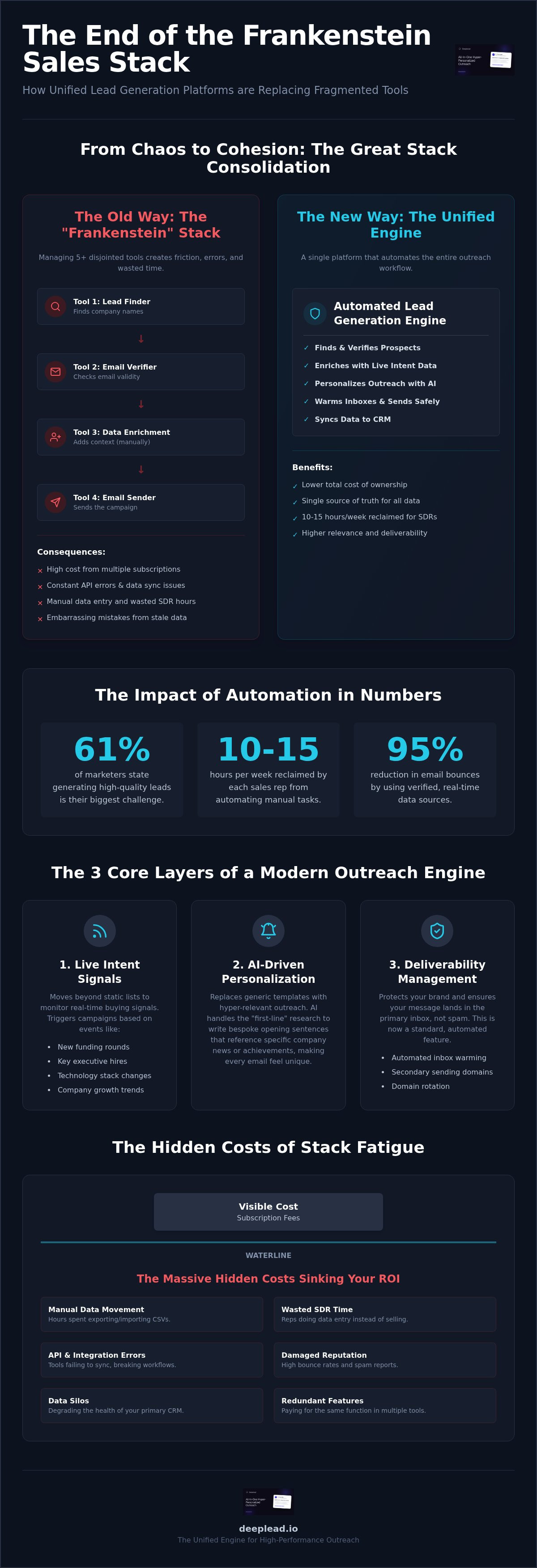
A true automation engine combines three core layers: data sourcing, AI-driven personalization, and deliverability management. It finds the right person, learns why they need your service, and ensures your message lands in their primary inbox. This replaces the fragmented "Frankenstein stack" where sales teams pay for five different subscriptions that don't talk to each other. By centralizing these functions, you create a transparent system that works quietly in the background. It allows you to scale your outreach without increasing your headcount or your stress levels.
The Evolution of B2B Lead Automation
The technology has evolved from basic web scrapers to sophisticated intent-based platforms. Early tools just collected names and emails. Modern software monitors live buying signals like new funding rounds, tech stack changes, or executive hires. AI now handles the heavy lifting of 'first-line' research. It writes personalized opening sentences that reference specific company achievements, making every email feel bespoke. Automated deliverability management has also become a standard feature. Tools now include inbox warming and domain rotation to navigate the aggressive spam filters of 2026. You no longer need to be a technical expert to maintain a high sender reputation.
Key Benefits for Sales Teams
Efficiency is the primary driver for adoption. Sales development representatives often reclaim 10 to 15 hours per week by automating the repetitive tasks of finding and verifying contacts. This consistency creates a pipeline that stays full even when your team is focused on closing active deals. You don't have to choose between prospecting and selling; the software handles the former so you can master the latter. Accuracy is another critical factor. By using verified data sources and real-time enrichment, you can eliminate up to 95% of email bounces. This protects your sender reputation and ensures your outreach remains profitable over the long term.
The Hidden Cost of 'Stack Fatigue' in Sales Teams
Many sales teams operate with a "Frankenstein stack." They pay for five or more subscriptions that don't communicate with each other. One tool finds the lead, another verifies the email, a third handles enrichment, and a fourth manages the sending. This fragmentation creates friction. It's common to see API connection errors or data enrichment fees that spiral out of control. These hidden costs eat into your margins and slow down your outreach momentum. When you use fragmented automated lead generation software, you're often paying for redundant features across multiple platforms.
Fragmented data leads to embarrassing outreach mistakes. When your tools aren't synced, you might send a cold email to an existing customer or reference a tech stack they stopped using two years ago. In 2026, prospects have zero tolerance for inaccurate messages. Moving toward a unified automated lead generation software platform ensures your data remains clean and your messaging stays relevant. It eliminates the "broken telephone" effect between your data source and your sending inbox.
Calculating the Real ROI of Your Sales Stack
Subscription fees are only the tip of the iceberg. The real cost lies in manual data movement. If your SDRs spend hours exporting CSVs and importing them into your CRM, they aren't selling. This manual labor creates data silos that degrade your HubSpot or Salesforce health. A single interface improves SDR focus; they spend their time responding to leads rather than troubleshooting software integrations. Consolidating your tools reduces the time spent on administrative tasks and increases the time spent on high-value sales meetings.
Why Unified Platforms are Winning
Unified platforms provide one source of truth for your contact data and outreach history. This clarity allows for better AI performance. When the software sees the entire funnel, it makes smarter decisions about which leads to prioritize based on previous engagement. It also simplifies your operations with a single bill and lower overhead. You can consolidate your outreach stack into a single engine that works quietly in the background. This shift toward all-in-one B2B outreach platforms is the defining trend of 2026, moving away from complex, fragile setups toward effortless precision. It allows your team to act as a sophisticated engine that values productivity and results.
Static lists are a relic of the past. In 2026, high-performance teams focus on intent signals rather than just contact numbers. Intent signals are live data points that indicate a company is in a buying window. These include events like new executive hires, recent funding rounds, or shifts in their technology stack. Effective automated lead generation software monitors these signals in real-time. It allows you to strike when the iron is hot. Instead of guessing who might need your service, you respond to concrete business events that prove a need exists.
The AI Deal Explorer is a core component of this strategy. It scans thousands of data points to identify high-value accounts that match your ideal customer profile perfectly. It doesn't just find names; it finds opportunities. This shift from volume-based prospecting to signal-based outreach ensures your sales team focuses only on the most promising leads. It transforms your outreach from a numbers game into a precision exercise. You aren't just sending mail; you're starting conversations with people who are already looking for solutions.
Trigger-Based Outreach Examples
Success depends on timing. When a prospect hires a new executive, it often signals a change in strategy or budget allocation. Your software can trigger an automated 'congrats' message that introduces your value proposition as a solution for their new goals. Similarly, a tech stack change is a prime opportunity for a 'switch' or 'integration' campaign. If a company receives a new funding round, they're likely scaling. An automated outreach offering scaling support lands exactly when they're looking for partners. These triggers ensure your message is relevant and timely, which is essential for capturing attention in a crowded inbox.
AI Personalization at Scale
AI has replaced the generic "I saw your post" template with genuine business relevance. Modern engines 'read' a prospect's LinkedIn profile or company website to find a unique hook. It identifies specific challenges or achievements and weaves them into the first line of your email. This level of detail used to take 20 minutes per lead. Now, it happens in seconds. Research shows that top-performing teams using AI-driven personalization often achieve reply rates of 15% to 25%, which is a massive jump from the 1% to 5% average seen with generic outreach. High-quality automated lead generation software makes this level of personalization possible at a scale that manual teams simply cannot match. You build trust immediately by moving beyond templates and focusing on real business value.
How to Implement Automation Without Burning Your Domain
Automation without a safety strategy is a liability. In 2026, spam filters are more aggressive than ever, using sophisticated AI to detect and block bulk outreach. If you send high volumes from your primary company domain, you risk blacklisting your entire corporate communication. High-quality automated lead generation software solves this by managing the technical infrastructure for you. It separates your sales activity from your main business operations, ensuring your everyday emails always land. You need a system that prioritizes safety over raw volume.
Implementation begins with a four-step process to secure your reputation. First, set up secondary domains that are similar but distinct from your primary one. Second, configure essential authentication protocols: SPF, DKIM, and DMARC. These records act as a digital passport, proving to email service providers that your messages are legitimate. Third, use a 'slow-ramp' sending schedule. Don't start with hundreds of emails; start with five and increase gradually. Finally, monitor your sender reputation daily. If engagement drops or bounce rates rise, the software should auto-pause your campaigns immediately to prevent permanent damage.
The Technical Foundation of Deliverability
Protecting your primary domain is the most important rule of outbound sales. By using secondary domains, you isolate your outbound campaigns from your internal communications. This prevents a single spam report from affecting your entire team. Automated 'warm-up' tools are essential during this phase. They simulate human interaction by sending and receiving messages between high-reputation inboxes. This builds trust with providers like Gmail and Yahoo before you send your first real pitch. To further protect your reputation, verify every email address in real-time. Eliminating invalid addresses ensures you stay well below the threshold for bounce-related penalties.
Best Practices for 2026 Outreach
Deliverability also depends on the quality of your copy. AI-generated messages must avoid 'spam-trigger' words like "guarantee," "winner," or "free" that modern filters flag instantly. Stick to the 50-per-day rule; limit each inbox to 50 outgoing messages to mirror natural human behavior. If you need to send 500 emails, use ten different inboxes rather than one. A unified reply management system is critical here. It allows you to track responses across all domains in one place, ensuring no lead is missed. You can get pre-warmed domains and managed inboxes to skip the technical setup and start scaling immediately. This methodical approach ensures your automated lead generation software remains a productive asset rather than a risk to your brand.
Deeplead: The Unified Engine for High-Performance Outreach
Deeplead is the answer to the fragmented sales stack. It combines contact data, AI research, and automated sending into one high-performing platform. Whether you're a solo founder or a scaling sales team, this automated lead generation software provides the infrastructure you need to win. You can choose the self-serve platform starting at $37 per month or opt for the $3,000 per month Done-For-You outbound service. This flexibility ensures your outreach scales alongside your business requirements without the need for manual data movement.
For teams focused strictly on ROI, the Pay-Per-Lead model offers a performance-driven alternative. You only pay for qualified replies, with costs ranging from $50 to $150 per lead. This model eliminates the uncertainty typically associated with outbound sales. Your CRM stays healthy because every lead syncs directly into HubSpot, Salesforce, or Pipedrive. You maintain a clean source of truth while the engine works in the background to find your next customer. It is a sophisticated engine that works quietly, allowing you to focus on closing deals rather than managing data.
Why Founders and Sales Leaders Choose Deeplead
Leaders choose Deeplead to eliminate tool fatigue. You manage your entire workflow in one place instead of paying for five different subscriptions. You get instant access to live buying intent signals through the AI Deal Explorer. This tool identifies high-value accounts automatically, so you don't have to spend hours on manual research. Deliverability is also a priority; every plan includes managed sending inboxes and pre-warmed domains to ensure your messages bypass spam filters. It's a professional, transparent system designed for ease of use and maximum impact.
Getting Started with Automated Lead Gen
Starting is straightforward. Select the model that fits your current stage: SaaS for hands-on teams, Pay-Per-Lead for performance focus, or Done-For-You for total outsourcing. Once your account is set up, you can launch your first signal-triggered campaign in less than 24 hours. This speed allows you to respond to market changes instantly without being bogged down by technical details. It's time to stop managing disjointed tools and start generating high-quality leads on autopilot. Start scaling your B2B outreach with Deeplead today.
Future-Proof Your Sales Pipeline
Consolidating your outreach into a single engine is the only way to scale in 2026. Fragmented stacks lead to data silos and missed opportunities. By switching to a unified automated lead generation software, you replace technical friction with a streamlined path to qualified meetings. Focus on intent signals and AI-driven research to ensure your message is always relevant and timely. This approach protects your domain reputation while maximizing your reply rates.
Deeplead simplifies this transition by removing the need for manual data movement. It integrates the AI Deal Explorer and warmed-up infrastructure into a single dashboard that syncs effortlessly with HubSpot, Salesforce, and Pipedrive. You can even choose a pay-per-qualified-reply model to ensure every dollar spent drives a real result. This transparency allows you to grow with confidence and predictable ROI.
Scale your B2B outreach with the Deeplead All-In-One Platform. It's time to let the engine handle the research while you focus on closing. Success is now a matter of precision, not volume. You have the tools to build a sophisticated, high-performing sales machine today.
Frequently Asked Questions
Is automated lead generation software legal under GDPR and CCPA?
Yes, automated outreach is legal if you follow specific regulations like GDPR and the CAN-SPAM Act. For GDPR compliance, you must establish a "Legitimate Interest" and ensure your message is highly relevant to the recipient's professional role. As of 2026, CAN-SPAM violations in the U.S. can result in fines up to $53,088 per violation. Using a professional platform ensures you include mandatory opt-out methods and accurate sender information to stay compliant.
How do I avoid my automated emails being marked as spam?
Avoiding spam filters requires a combination of technical infrastructure and natural sending patterns. You should use secondary domains and pre-warmed inboxes rather than your primary company domain. Configuring SPF, DKIM, and DMARC records is essential to prove your identity to email providers. Modern automated lead generation software also implements daily sending limits, typically around 50 emails per inbox. This prevents the bulk sending spikes that trigger aggressive 2026 spam filters.
Does Deeplead integrate with my existing CRM like HubSpot or Salesforce?
Deeplead integrates directly with major CRM platforms including HubSpot, Salesforce, and Pipedrive. This connection ensures your outreach data and new leads sync automatically without manual CSV exports. When a prospect provides a qualified reply, the software updates the contact record in your CRM in real-time. This synchronization eliminates data silos and helps your sales team maintain a single source of truth. It allows for a seamless transition from automation to human-led closing.
What is the difference between a lead list and intent-based signals?
A lead list is a static collection of contacts, while intent-based signals are live triggers indicating a prospect is currently in a buying window. Lead lists often contain stale data and lead to high bounce rates. Intent signals monitor real-time events like new funding rounds, executive hires, or technology stack changes. Using automated lead generation software to target these signals ensures your outreach is timely. You aren't just messaging a name; you're responding to a specific business need.
Can I automate lead generation on LinkedIn with this software?
No, Deeplead does not offer LinkedIn automation or LinkedIn outreach services. The platform is strictly focused on B2B email outreach using verified contact data and AI-personalized messaging. While multi-channel strategies are common, this software prioritizes high-deliverability email infrastructure and intent-based campaigns. This focus ensures your domain reputation remains secure while providing a specialized engine for professional email communication. It is designed to act as a sophisticated engine that works quietly in the background.
How much does automated lead generation software typically cost in 2026?
Costs vary based on the model you choose. Building an in-house AI lead generation system typically costs between $2 and $15 per lead, while managed services for SMBs often range from $200 to $2,000 per month. Deeplead offers a self-serve SaaS platform starting at $37 per month. For teams focused on ROI, pay-per-lead models generally cost between $50 and $150 per qualified reply. This range allows businesses to scale their outreach budget based on predictable performance results.
What is a 'qualified reply' in the pay-per-lead model?
A qualified reply is a response from a prospect that indicates genuine interest or a request for further information. This definition excludes automated "out of office" messages, "wrong person" referrals, or simple unsubscribe requests. In the pay-per-lead model, you only pay when a potential customer engages positively with your outreach. This performance-based approach ensures your budget is spent on high-value conversations that have a real chance of converting into a booked meeting or deal.
Do I need technical skills to set up automated outreach?
You don't need advanced technical skills to launch an automated campaign. Modern platforms handle complex tasks like inbox warming and DNS configuration in the background. The interface guides you through selecting data and applying AI personalization with just a few clicks. If you prefer a completely hands-off approach, the Done-For-You model manages the entire technical infrastructure for you. This allows founders and sales leaders to focus on closing deals rather than troubleshooting software integrations.